
If you are a Volvo owner, buyer, or enthusiast, you have likely encountered two important documents: the window sticker and the build sheet. While both provide valuable information about your vehicle, they serve different purposes and contain distinct types of data.
Understanding the differences between these two documents can help you verify factory options, authenticate a vehicle’s history, order the correct replacement parts, and make informed purchasing decisions.
Let’s break down exactly what sets a Volvo window sticker apart from a build sheet, and why both matter for anyone invested in a Volvo.
What is a Window Sticker?
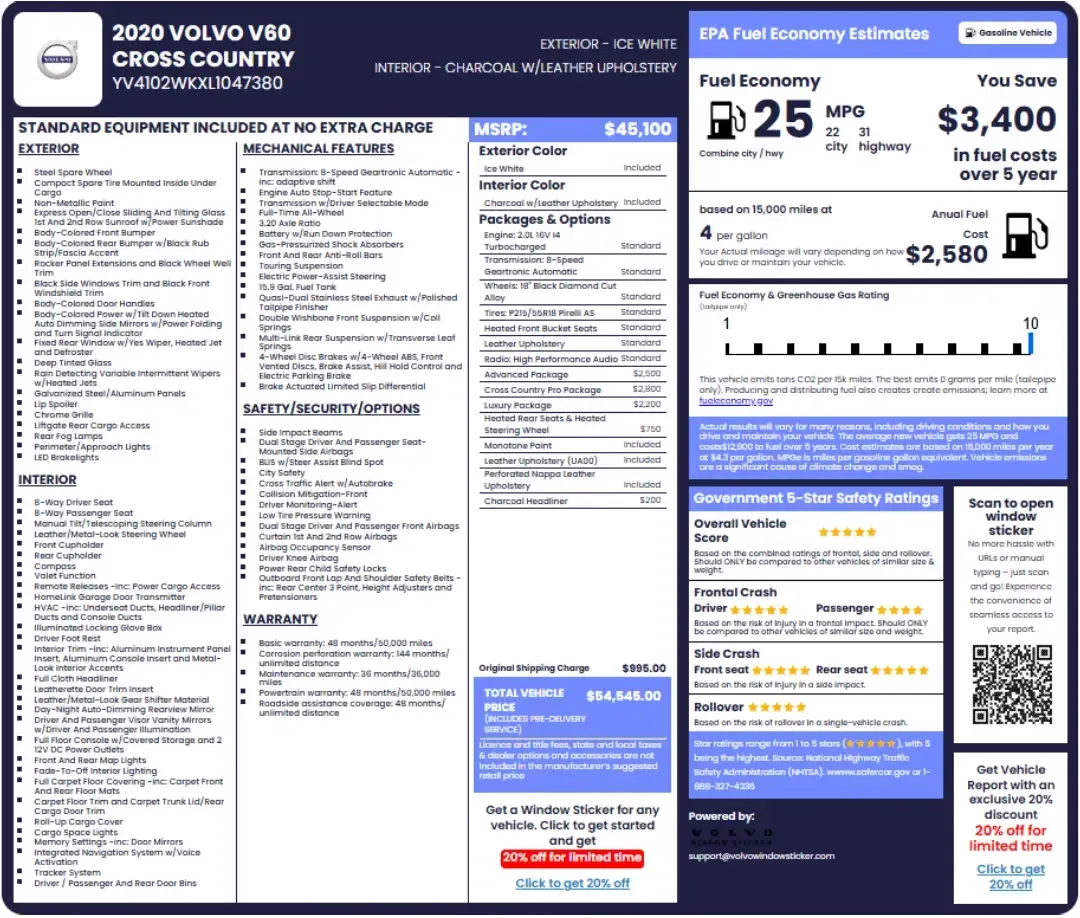
A window sticker, formally known as the Monroney label, is the federally mandated label affixed to the window of every new vehicle at the time of sale. It is designed to provide transparency to consumers by displaying essential information about the vehicle’s pricing, specifications, and fuel economy.
Characteristics
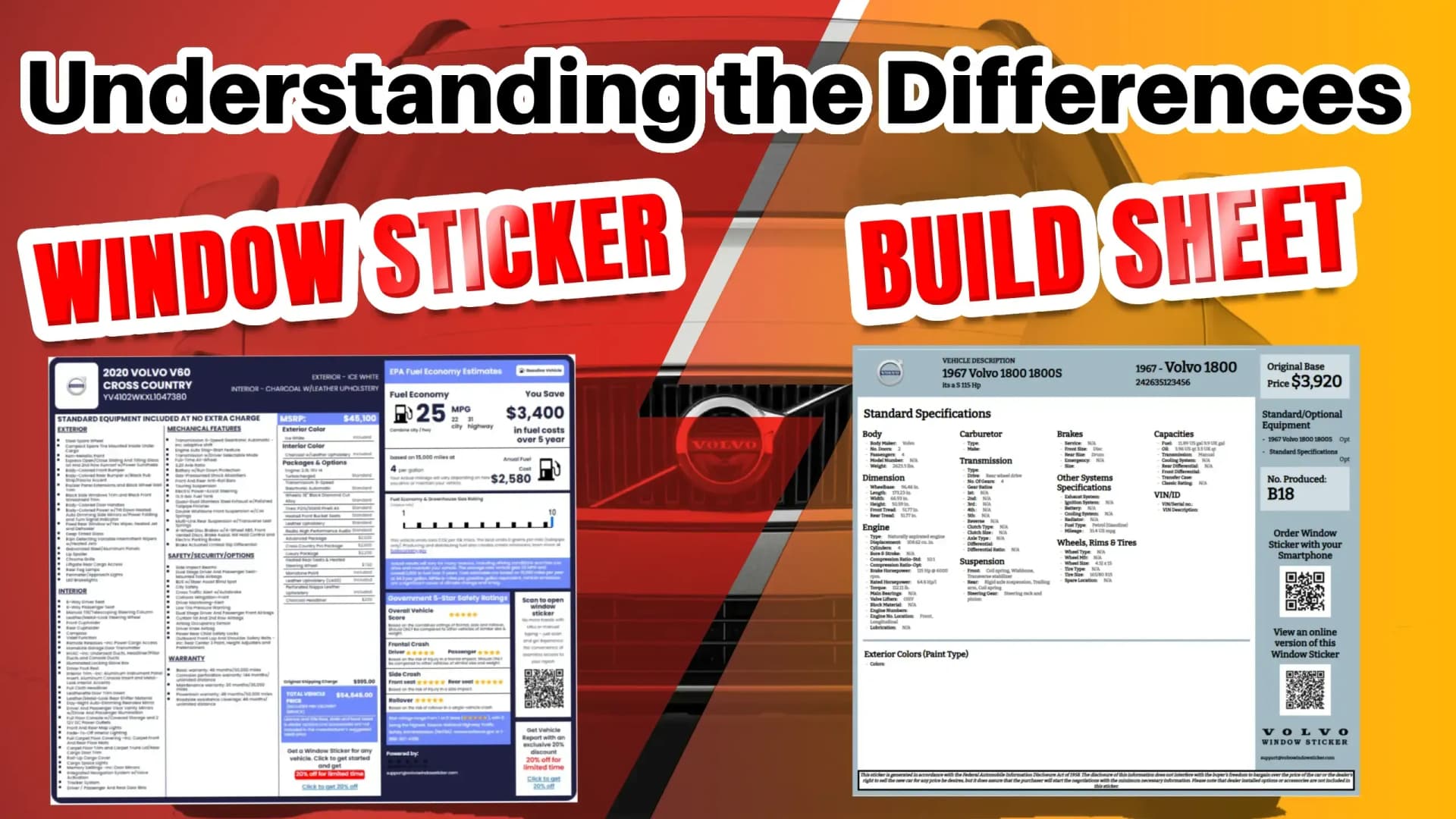
The window sticker and the build sheet may cover overlapping vehicle details, but they serve fundamentally different purposes. A window sticker is designed for buyers, clearly showing pricing, features, and official ratings at the point of sale. In contrast, a build sheet focuses on how the vehicle was assembled at the factory, listing production codes and internal specifications rather than consumer-friendly marketing language.
Legal Requirement
The window sticker is mandated by the Automobile Information Disclosure Act of 1958. This federal law requires that all new vehicles sold in the United States display a label showing the manufacturer’s suggested retail price (MSRP), standard equipment, and optional features with their costs. The same principle applies in many other markets, making the window sticker a universal U.S. consumer protection tool.
Consumer-Facing Document
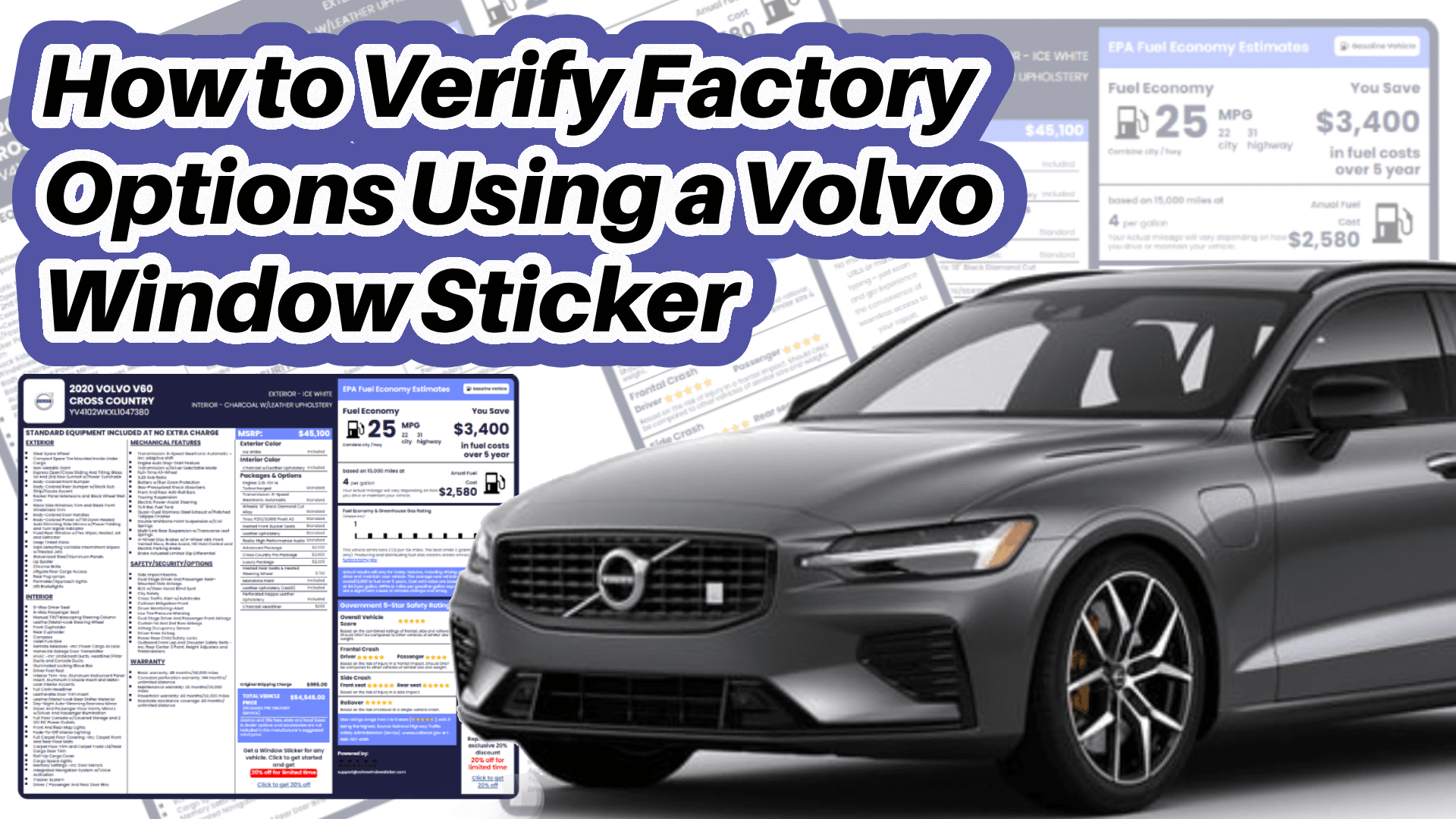
The window sticker is intended for buyers and dealers. It summarizes the vehicle’s key selling points in an easy-to-read format, helping consumers compare models and understand exactly what they are paying for. For Volvo models ranging from the XC90 to the S60, this document turns a long list of available packages and standalone options into digestible, transparent information.
Information Included
- MSRP: Base price, cost of optional packages, standalone options, and destination charge
- Standard Features: Equipment included with the chosen trim level (e.g., Momentum, R-Design, Inscription)
- Optional Equipment: Factory-installed packages like the Advanced Package or Climate Package, plus individual options like Bowers & Wilkins Premium Sound, with their respective pricing
- Fuel Economy: EPA-estimated city, highway, and combined MPG
- Safety Ratings: Crash test ratings and the inclusion of Volvo’s IntelliSafe active safety features
- VIN: The 17-digit Vehicle Identification Number
- QR Code / Barcode: For digital verification at dealerships
Primary Purpose
The window sticker serves as a consumer protection tool, ensuring buyers know exactly what they are purchasing and at what cost before signing any paperwork. For a premium brand like Volvo, it clearly communicates the value of included Scandinavian luxury, safety innovations, and powertrain choices.
What is a Build Sheet?
A build sheet, also known as a factory build sheet, vehicle specification sheet, or production broadcast sheet, is created during the manufacturing process and follows the vehicle down the assembly line.
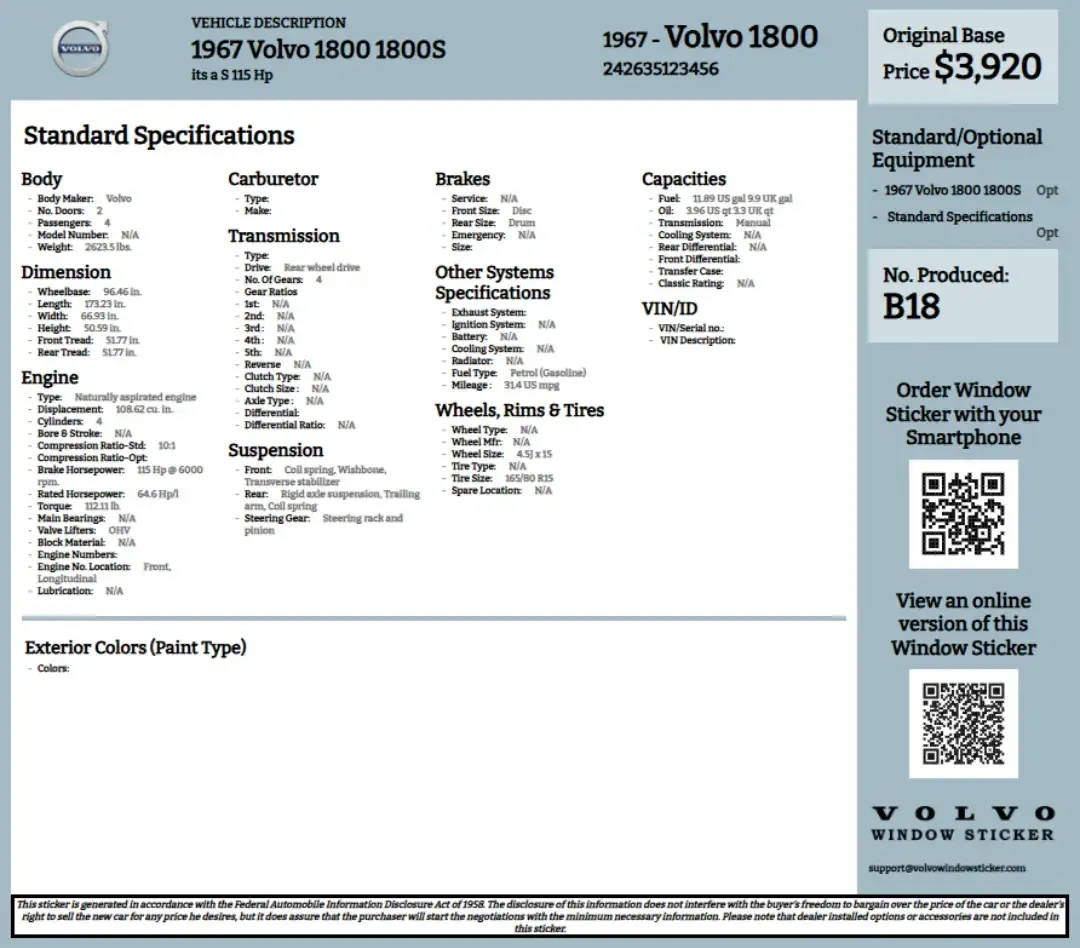
For Volvo, this document is a granular record of how the car left the factory in Torslanda, Ghent, or any of its global production facilities.
Characteristics
Internal Factory Document
The build sheet was originally created for manufacturing and assembly. Build sheets are now widely used by vehicle owners, restorers, technicians, and collectors to verify factory specifications, identify the correct replacement parts, and confirm how a Volvo was originally configured.
Every Volvo leaves the factory with production records that document its original configuration. Depending on the model year and market, these records may exist as a physical build sheet, an option-code label, or a digital factory record accessible through VIN-based systems.
Comprehensive Component List
Unlike the window sticker, which summarizes key features, the build sheet provides an exhaustive list of every major component and many minor parts used in the vehicle, including:
- Engine code (e.g., B4204T23 for a T5 turbocharged engine, D4204T14 for a D4 diesel)
- Transmission code (e.g., TG-81SC 8-speed automatic, M66F 6-speed manual)
- Paint code (e.g., 612 Passion Red, 714 Crystal White Pearl, 019 Black Stone)
- Interior trim code (e.g., RA00 for Charcoal Leather, RC20 for Blond Nappa Leather)
- Suspension and brake system variants
- Control modules and software versions
- Every wiring harness, sensor, and optional hardware component is fitted during assembly
Multiple Formats
Build sheets may appear in different forms:
| Paper sheet Historically, a physical sheet of paper that traveled down the assembly line with the vehicle body. | Digital record Modern Volvos store the complete build data electronically in the manufacturer’s centralized database, accessible by dealers worldwide. | Vehicle identification plate/sticker Many Volvos include a sticker or plate listing key option codes in locations such as the spare tire well, under the hood, or on the B-pillar. The service booklet often contains a similar sticker. |
|---|
← Scroll horizontally to see more →
Primary Purpose
The build sheet serves as the master blueprint for manufacturing, ensuring that each Volvo is assembled correctly. For owners and independent specialists, it is also the ultimate reference for parts ordering, restorations, and verifying exactly how the car was equipped when it left the factory.
Volvo Window Sticker vs Build Sheet Comparison
| Feature | Window Sticker (Monroney Label) | Build Sheet (Factory Build Sheet) |
|---|---|---|
| Intended Audience | Consumers and dealers | Factory workers, technicians, parts specialists |
| Legal Status | Federally mandated for new car sales (U.S.) | Internal factory document; not legally required |
| Information Detail | Summary of pricing, packages, and fuel economy | Comprehensive list of every component, part number, and option code |
| Option Codes | Descriptions only (e.g., “Bowers & Wilkins Premium Sound”) | Volvo-specific product codes (e.g., “553” for Bowers & Wilkins) |
| Pricing Information | Yes. MSRP, option costs, destination charge, gas guzzler tax (for applicable Volvo cars) | Pricing details are rarely included |
| Component-Level Details | No. Only major packages and standalone options | Yes. Down to individual sensors, wiring harnesses, and trim pieces |
| Fuel Economy | Yes. EPA estimates | No |
| Availability | Often lost; can be recreated using the VIN or chassis number | Often found on a sticker in the spare tire well, service booklet, or dealer database |
| Best For | Verifying original MSRP, packages, and consumer-level equipment | Ordering correct parts, confirming exact factory specifications, and restoration projects |
← Scroll horizontally to see more →
When Should You Use a Volvo Window Sticker or Build Sheet?
Both the window sticker and the build sheet contain information about your Volvo, but they excel in different scenarios. Knowing which document to reach for will save you time, money, and potential frustration.
Window Sticker is Best For
If you plan to purchase a used Volvo, the window sticker helps check what specifications and features the vehicle had when it was new.
Checking if the Factory Packages Don't Match
The window sticker lists every major package (e.g., Advanced Package, Climate Package, Lounge Package) and standalone option (e.g., Air Suspension, Bowers & Wilkins audio, Head-Up Display) that should match the equipment listed on the sticker. Missing
Factory features can indicate removed or replaced components.
Confirm Exterior or Interior Never had Been Changed
The sticker lists the original paint color and interior upholstery. If the vehicle now has a different
paint color or trim, ask whether it has been repainted or reupholstered.
Review Original Pricing
The sticker breaks down the base MSRP and factory options, helping you understand the vehicle's original value.
Check Safety and Fuel Economy
View the original EPA fuel economy estimates, safety ratings, and warranty information
Exactly as they appeared on the factory sticker.
Resale and Trade-In Documentation
Providing a window sticker to potential buyers or dealers adds transparency and credibility. It demonstrates that the vehicle’s equipment is factory-original and can often help justify a higher asking price or trade-in value.
Build Sheet is Best For
A build sheet is the best choice when you need complete factory specifications for a Volvo. It identifies original specifications, installed equipment, production details, and component information, making it valuable for ordering the correct parts, verifying factory originality, restoring classic Volvos, and confirming technical specifications before repairs or resale.
Ordering Replacement Parts
When ordering parts from a Volvo dealership or online supplier, the build sheet (specifically the Volvo option codes) ensures you receive the correct component. For example, the same model year XC90 may have different brake calipers, suspension components, or infotainment modules depending on the build specification. Providing the exact code eliminates guesswork.
Confirming Exact Specifications
If you need to know the paint code for a touch‑up pen, the interior trim code for replacement upholstery, or the engine variant for performance upgrades, the build sheet delivers. The window sticker will tell you the car has “Blond Nappa Leather,” but the build sheet will give you the exact code “RC20” that the parts department needs.
Restoration and Collector Verification
For classic Volvos like the P1800, 240 Turbo, or 850 T-5R, the build sheet is a critical piece of provenance. It confirms whether the car originally rolled out of the factory with the optional sport seats, the limited-slip differential, or a specific paint and stripe combination. For modern collectibles like a Polestar Engineered model, the build sheet verifies the complete performance specification.
Service and Repair
Volvo service technicians and well-equipped independent shops often refer to the build sheet (or its digital equivalent in VIDA) to identify the correct software version for control modules, verify recall eligibility, and determine whether a component is original equipment or an aftermarket replacement.
Understanding Volvo Option Codes (Product Codes)
One of the clearest differences between a window sticker and a build sheet is the presence of option codes. While the window sticker lists options in plain English, the build sheet uses a standardized system of Volvo-specific codes, often referred to as product codes or vehicle option codes.
What Are Volvo Option Codes?
A Volvo option code is typically a three-digit (sometimes alphanumeric) identifier that corresponds to a specific factory-installed component or feature. These codes are used across Volvo’s global production system to track exactly what each car received. For older models, you might find numeric codes; newer SPA and CMA platform vehicles continue this tradition with a structured coding system.
These codes are usually found on a sticker placed on the vehicle itself—common locations include the spare tire well, the inside of the service booklet, the underside of the hood, or the B-pillar, and in Volvo’s internal VIDA database. Knowing them is essential for accurate parts matching.
Common Volvo Option Codes
Check some examples of the Volvo option codes and their meaning with the table below:
| Option Code | Description |
|---|---|
| 553 | Bowers & Wilkins Premium Sound System |
| 608 | City Safety (Collision Avoidance) |
| 640 | Park Assist Pilot (Self-Parking) |
| 603 | BLIS (Blind Spot Information System) |
| 500 | Heated Front Seats |
| 524 | Heated Rear Seats |
| 322 | Panoramic Sunroof |
| 112 | Power Operated Tailgate |
| 771 | 20" 5-Double Spoke Alloy Wheels |
| 615 | Pilot Assist (Driver Assistance) |
| 000450 | Air Suspension with Four-C |
| 000065 | Head-Up Display |
← Scroll horizontally to see more →
(Note: Codes may vary by model year and market. Always verify using the official build data.)
How to Find Your Volvo’s Option Codes
- Spare Tire Well: Lift the trunk floor in an XC60, XC90, V60, or V90 and look for a large white or black sticker covered in codes. This is often the most complete physical record.
- Service Booklet: The inside cover of the original service and warranty booklet typically holds an identical sticker.
- B-Pillar or Under-Hood Plates: Some models place a trimmed-down version of these codes on the vehicle identification plate.
- Digital Lookup via VIN: Our dedicated Volvo services provide a Volvo window sticker, which can also retrieve the detailed build data from the VIN. even for an old vehicle that others can’t decode with 5-14 characters.
How to Obtain a Window Sticker or Build Sheet
You can access both a window sticker and a build sheet using the 17-digit VIN. Multiple avenues exist, from official dealership records to specialized online services that recreate these documents for any Volvo.
Obtaining a Window Sticker
To obtain the window sticker, you may use your Volvo VIN. Once you’ve decoded the VIN, you will get the original copy of the Volvo window sticker.
Original Window Sticker
The original paper sticker was attached to the window when the Volvo was new. If you are the original owner, it may still be among your glovebox documents or service records. For used vehicles, the original is often long gone.
Recreated Window Sticker by VIN
If you no longer have the original Volvo window sticker, our Volvo Window Sticker Lookup can recreate it using the VIN, classic chassis number (5–14 digits), license plate, or vehicle details (year, make, model) without requiring a dealership visit.
Using an online service that specializes in Volvo window stickers by VIN, you can generate a digital replica that displays the original MSRP, itemized optional equipment, EPA fuel economy ratings, and standard trim-level features.
Our Volvo Window Sticker Lookup can recreate the original window sticker and retrieve factory build information using the VIN and classic chassis numbers from 5 to 14 digits, U.S license plate, or the Volvo models and year, making it easier to verify original equipment, pricing, specifications, and production details without visiting a dealership.
Volvo Dealership
An authorized Volvo retailer can print a replica window sticker or a detailed vehicle inquiry report using the VIN. Some dealers may charge a fee and may require an in-person visit or a formal request.
Obtaining a Build Sheet
Physical Sticker on the Vehicle
The easiest and cheapest method is to locate the option code sticker yourself. Check the spare tire well, the service booklet, under the hood, or the B-pillar. A quick photo of this sticker gives you all the codes you need for parts ordering.
Online VIN Decoding Services
Several online VIN decoders and Volvo enthusiast tools can generate a partial build sheet. With Online build sheet lookup, you can get the original build data, even for vintage pre-1980s Volvos with VINs less than 17 digits.
Volvo Dealer VIDA Printout
A Volvo dealership can access the full electronic build data (often called the “Vehicle Specification” or “Factory Build” report) via the VIDA system. This printout will list every option code with a description, the engine and transmission serial numbers, and software part numbers. Dealers can usually provide this during a service visit or upon request.
Common Misconceptions
It is easy to confuse a window sticker with a build sheet because both describe the vehicle. However, they are built for different audiences and carry unique levels of detail.
“The window sticker and build sheet are the same thing.”
Fact: They are completely different documents. The window sticker is a consumer-facing marketing and pricing summary. The build sheet is a granular, internal factory document that lists every component used to assemble the vehicle, down to the last module and fastener.
“The build sheet shows the MSRP.”
Fact: Build sheets contain zero pricing information. They are technical assembly documents. If you need the original MSRP or the cost of the Climate Package on a 2019 XC60, the window sticker is the correct document.
“You don’t need the build sheet if you have the window sticker.”
Fact: The window sticker is sufficient for buying and selling. However, the build sheet is indispensable for ordering the correct brake pads (which may vary based on a specific suspension code), confirming the exact paint formula, or proving the original engine variant for a classic Volvo restoration.
“Build sheets are only for classic cars.”
Fact: Every Volvo (from a brand-new EV car to a pre-1980s Volvo) has a build sheet or its digital equivalent. The format may have evolved from paper to a cloud-based database, but the concept and utility remain identical.
FAQs About Volvo Window Sticker vs. Build Sheet
Which document is more useful for a used Volvo buyer?
For most buyers, the window sticker is more immediately useful. It shows the original MSRP, trim, packages, and options in plain English, helping you verify that the car has the equipment advertised. The build sheet becomes important later for parts and detailed specification verification.
Can I get a build sheet for my Volvo using the VIN?
Yes. Any authorized Volvo dealer can pull the complete factory build data from the VIN and provide a printout. Online services may offer partial data, but a dealer VIDA readout remains the gold standard for accuracy.
Does the window sticker include Volvo option codes?
No. The window sticker describes features with consumer-friendly names like “Bowers & Wilkins Premium Sound.” It does not show the corresponding three-digit option code (e.g., “553”) required for parts ordering. You need the build sheet or a dealer printout for those codes.
Where can I find the option code sticker on my Volvo?
Look in the spare tire well, on the inside cover of the service booklet, under the hood near the latch, or on the B-pillar. A white or black sticker with numerous three-digit codes is what you’re looking for.
Why would I need the build sheet if I already have the window sticker?
The window sticker tells you that your Volvo has the “Advanced Package” or “Air Suspension.” The build sheet tells you the exact suspension hardware codes, the specific audio amplifier part number, and the correct replacement component for your VIN. When it’s time for a repair, this level of detail eliminates mistakes.
Is the build sheet the same as a VIN decoder?
No. A basic VIN decoder pulls information encoded in the 17-character VIN, such as the engine type, model year, and assembly plant. The build sheet expands that to hundreds of individual option codes, covering everything from the steering wheel stitching color to the market-specific headlight variant—far more detail than a VIN alone can provide.
Do modern Volvos still have physical build sheets?
Most modern Volvos do not include a paper sheet that travels down the assembly line, but the build data is captured digitally and remains fully accessible. Many vehicles still carry a physical option code sticker in the spare tire well or service booklet. The dealership can always retrieve the full electronic specification.
Can I use the build sheet to verify factory options for resale?
The build sheet is technically the most accurate record, but private buyers often find the window sticker easier to read. Providing both documents when selling your Volvo demonstrates exceptional transparency and can increase buyer confidence, particularly with well-optioned or special edition models.