

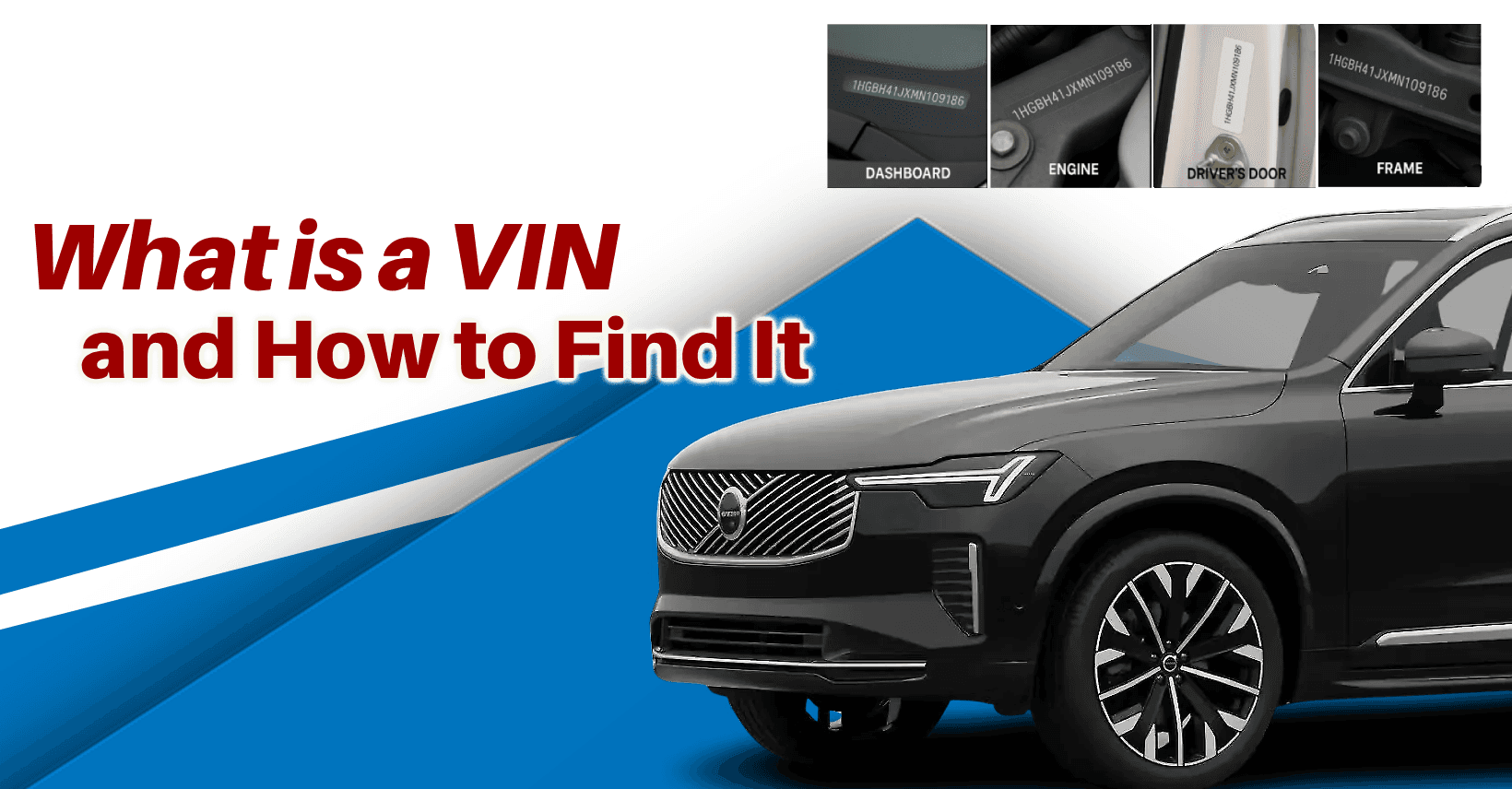
The VIN is one of the most important pieces of information attached to a Volvo. It connects the vehicle to registration records, ownership documents, factory specifications, and original equipment details. Whether you’re verifying a used XC90 or researching a classic 1800S, the VIN is almost always the starting point.
Key Takeaways:
- A VIN is a unique code that identifies each Volvo individually.
- On modern Volvos, the VIN can usually be found on the driver’s side dashboard near the windshield and on the driver’s side door jamb.
- The VIN also appears on Volvo paperwork, such as the title, registration, and insurance documents.
- Using A Volvo VIN decoder lookup, you don’t need to memorize what each code means. The tools can decode all the Volvo models, even the classic ones with chassis numbers less than 17 digits, at no cost.
What Is a VIN?
A Vehicle Identification Number (VIN) is a unique identifier that every Volvo leaves the factory with. Whether you’re registering a vehicle, getting insurance, researching a used Volvo, or looking for the original window sticker, the VIN is the key.
Two Volvos that look identical on paper can have different engines, trim levels, technology packages, or factory-installed options. That’s why the VIN is so valuable. It helps connect a specific Volvo to its factory specifications and original records.
Many people assume every vehicle uses the same VIN format. Every vehicle has some form of identification number, but modern Volvos use a standardized 17‑character VIN, while many older classic Volvos use shorter VINs, chassis numbers, or serial numbers.
The Difference Between Modern and Classic Volvo VINs
Beginning with the 1981 model year, vehicles sold in the United States adopted the standardized 17-character VIN format required under federal regulations and aligned with ISO 3779. This modern system gives every Volvo a unique identifier that can be used throughout its lifetime.
Unlike modern VINs, which follow a common structure, classic Volvo VINs were developed independently by Volvo and have no universal standard. Two Volvos built in the same year but different model lines may use completely different identification systems. As a result, decoding a classic Volvo often requires model‑specific knowledge rather than a one‑size‑fits‑all VIN format.
How a Modern 17‑Character Volvo VIN Works
All modern Volvos sold in the United States use a standardized 17‑character VIN. Each character serves a specific purpose, using numbers (0‑9) and letters (A‑Z) while entirely excluding “I”, “O”, and “Q” to avoid confusion. The VIN is divided into three sections:
- World Manufacturer Identifier (WMI): Characters 1–3 identify Volvo as the manufacturer.
- Vehicle Descriptor Section (VDS): Characters 4–9 describe the vehicle's configuration, such as the model, engine, restraint system, and include the check digit on North American vehicles.
- Vehicle Identifier Section (VIS): Characters 10–17 identify the model year, assembly plant, and the vehicle's unique production number.
A Volvo VIN helps identify:
- Manufacturer
- Model
- Model year
- Trim level
- Engine specifications
- Assembly plant
- Vehicle type
- Production sequence
That’s one reason Volvo VINs are used every day by dealerships, insurance companies, lenders, auction houses, and vehicle marketplaces.
Example of a 17‑Character Volvo VIN (YV4A22PK6G1234567)

The Volvo VIN YV4A22PK6G1234567 from a 2016 XC90 shows how information is distributed throughout a modern VIN. Some characters identify the manufacturer, others describe how the vehicle was built, and the final section helps distinguish that specific Volvo from every other one produced.
- YV4 – World Manufacturer Identifier (Volvo multipurpose vehicle)
- A22 – Model and engine type (XC90 T6 AWD)
- PK – Trim level (Momentum)
- 6 – Check digit
- G – Model year (2016)
- 234567 – Production sequence number
Every VIN can help verify details about a Volvo and connect it to factory records. You don’t need to memorize what every position means. Many Volvo owners use our VIN decoder tools to access factory‑issued vehicle information accurately and in seconds.
How a Pre‑1980s Classic Volvo VIN Works
Things get more interesting when you start looking at classic Volvos. Classic Volvo identification numbers work differently because there was no industry‑wide standard before 1981. Many old vintage Volvos may use a VIN, chassis number, or factory identification number ranging from 5 to 14 characters, although the exact format depends on the vehicle.
A Volvo 1800S, Amazon, or P1800 from the same era can use a completely different format, even if the vehicles were built in the same year. That’s why classic Volvo VIN decoding isn’t a one‑size‑fits‑all process.
Example of a 12-Digit Classic Volvo Chassis Number (242635123456)

If you're trying to decode a classic Volvo, don't expect to see the standardized 17-character VIN used on modern vehicles. Volvo used several different numbering conventions to identify its vehicles.
For this particular 1967 Volvo 1800S, the 12‑digit 1967 Volvo 1800S chassis number (242635123456) can be interpreted as follows:
| Section | Value | Meaning |
|---|---|---|
| 24 | Volvo 1800 Series | Model family (Volvo P1800/1800) |
| 26 | 1800S Coupe | Body/model designation |
| 35 | 1967 model year | Production year |
| 123456 | Serial number | Individual production sequence |
← Scroll horizontally to see more →
The following example illustrates how one specific 1967 Volvo 1800S chassis number can be decoded. This format applies to this model family and production period only. Other classic Volvo models, including the Amazon, PV544, 140 Series, and Duett, may use different numbering systems and require a specialized Volvo classic decoding.
Where to Find the VIN on a Volvo
Finding the VIN is important for Volvo registration, insurance, ownership verification, and vehicle research. For most Volvo cars, SUVs, and wagons, the VIN is usually located in an easy-to-inspect location.

On the Vehicle
- On the driver’s side dashboard, near the windshield
- Driver’s side door jamb (on the sticker or stamped into the body)
- On some models, the VIN is also stamped on the front right shock tower under the hood
Vehicle Documents
- Title certificate
- Registration documents
- Insurance records
- Manufacturer or dealer service records
These locations are designed to make Volvo identification easier during registration, inspections, and ownership verification.
For pre-1981 classic Volvos
Classic Volvos often identify the vehicle using a chassis number instead of today's standardized VIN. Depending on the model, this number may appear on an identification plate, a firewall tag, or be stamped directly into the body or chassis.
Because Volvo used different identification systems before 1981, the location and format vary between models such as the Amazon, PV544, 140 Series, and 1800.